
ISO 17712:2013 specifies the requirements for mechanical seals used on freight containers. These seals are critical for securing containers during international transport and preventing unauthorized access or tampering. The standard applies to high-security seals, security seals, and indicative seals, each serving different levels of protective assurance.
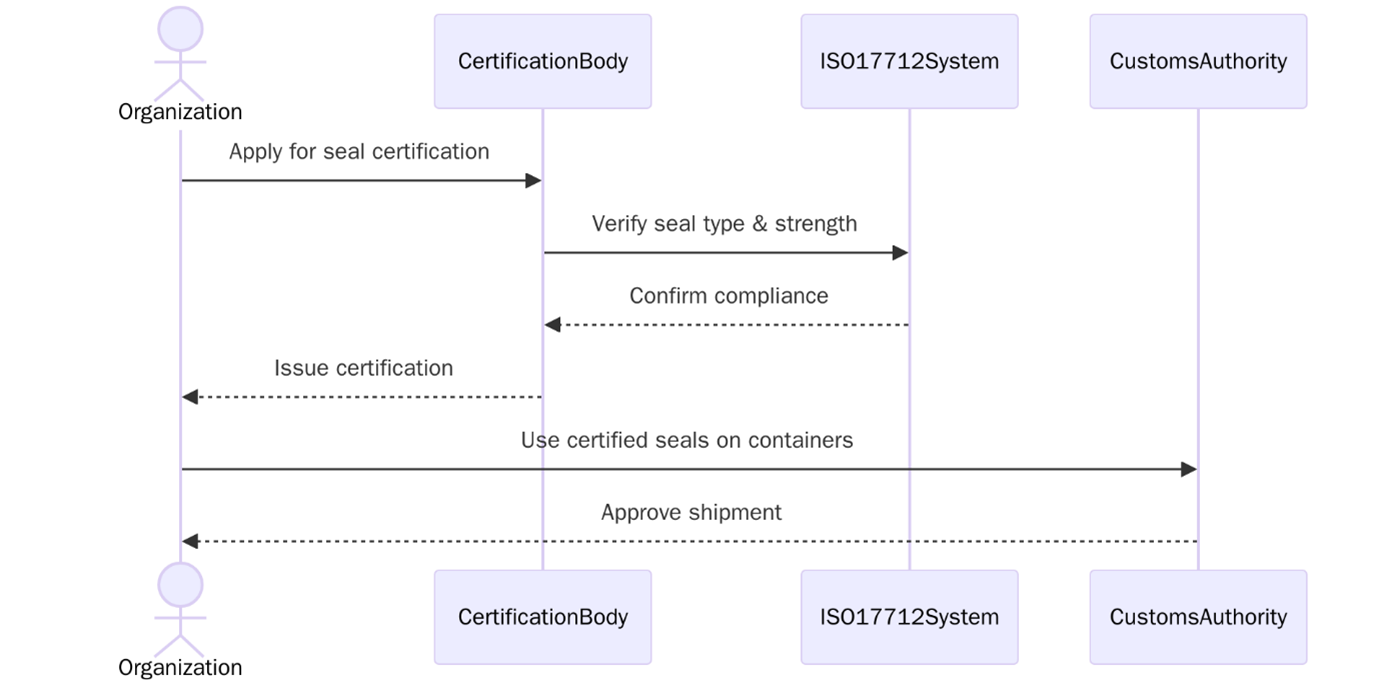
Developed in collaboration with customs, freight authorities and supply chain operators, ISO 17712 helps to ensure container integrity from origin to destination, playing a key role in supply chain security and compliance with customs and anti-terrorism programs like C-TPAT (U.S.) and AEO (EU).
If you are looking for ISO 17712 certification for container seals, contact us at support@demo.pacificcert.com
The purpose of ISO 17712:2013 is to:
If your company manufactures or distributes container seals, contact us at support@demo.pacificcert.com
This standard defines mechanical requirements, tamper evidence features, and test procedures for seals used on freight containers in international commerce. It applies only to single-use mechanical seals and excludes reusable locking mechanisms or electronic tracking seals.
Applicability:
ISO 17712 is relevant to:
If you are looking to certify seals under ISO 17712, contact us at support@demo.pacificcert.com
If you need assistance understanding seal categories and compliance, contact us at support@demo.pacificcert.com
Clause | Title | Overview |
1 | Scope | Defines the application and exclusions of the standard. |
2 | Normative References | Lists other standards essential for application (e.g., ISO 868). |
3 | Terms and Definitions | Provides terminology for seals, testing, tamper evidence, etc. |
4 | Classification of Seals | Categorizes seals into indicative, security, and high-security classes. |
5 | General Requirements | Addresses seal structure, materials, and general design rules. |
6 | Physical Strength Test Requirements | Details mandatory strength tests for each class of seal. |
7 | Tamper Evidence Requirements | Specifies how seals must show visible evidence of forced entry or tampering. |
8 | Marking Requirements | Details required identification marks (e.g., manufacturer ID, unique serial number). |
9 | Test Procedures | Describes laboratory test conditions and parameters. |
If you require audit support for ISO 17712, contact us at support@demo.pacificcert.com
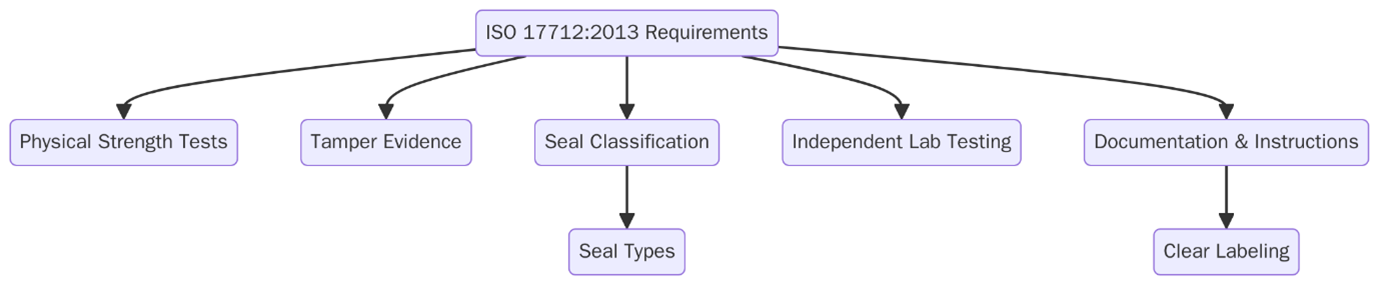
To comply with ISO 17712:2013, manufacturers and users of container seals must:
Seal Type | Description |
Indicative Seal | Detects tampering but offers little resistance to forced entry (low strength). |
Security Seal | Offers moderate resistance; requires tools for removal (medium strength). |
High-Security Seal | Designed for high-risk shipments; must meet stringent strength tests (e.g., bolt and cable seals). Certified under C-TPAT. |
Only high-security seals are acceptable under C-TPAT and similar customs security programs.
Each test simulates realistic tampering or forced removal scenarios and sets minimum strength thresholds for each seal category. Other requirements are:
If you are preparing seals for compliance testing, contact us at support@demo.pacificcert.com.
If you need help assembling documentation for ISO 17712 certification, contact us at support@demo.pacificcert.com
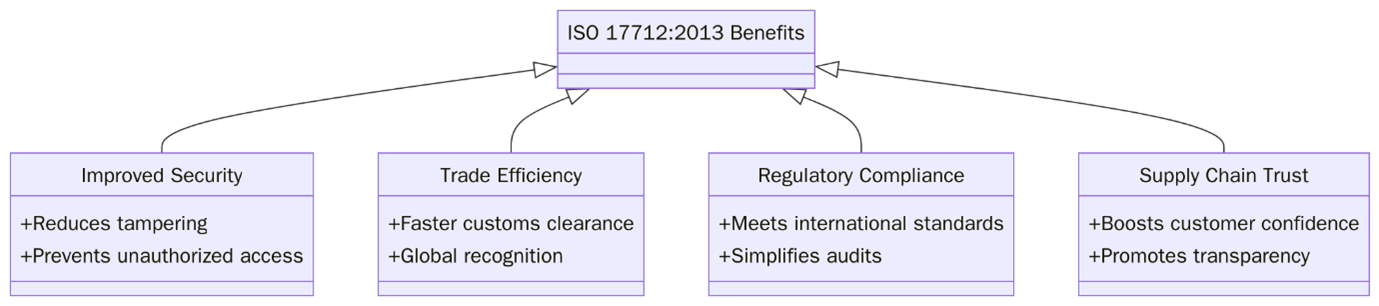
ISO 17712:2013 enhances global cargo security by providing a standardized method for classifying and testing mechanical seals used on freight containers. By ensuring seals are tamper-evident, uniquely identifiable, and resistant to unauthorized access, the standard helps prevent theft, smuggling, and cargo tampering during international transit. Below are the other benefits:
Recently, demand for ISO 17712-certified high-security seals is rising due to increasing threats to global trade, including container theft, counterfeit goods, and smuggling. Government authorities are tightening import/export regulations, and supply chains are being required to show documented security practices.
Technologies like blockchain traceability, smart seals with GPS or RFID, and biometric locks are emerging alongside traditional seals. However, mechanical seals remain the first line of defense for freight container security, especially where electronic tracking is not feasible.
Logistics operators, third-party freight handlers, and even insurance companies are now factoring ISO 17712 compliance into risk assessments, making certification an essential part of international trade readiness.
If you are manufacturing or sourcing container seals for export markets, contact us at support@demo.pacificcert.com.
Obtaining ISO 17712 certification follows a structured and time-bound process that spans 4 to 6 weeks, depending on the complexity of the product and availability of laboratory testing. Here’s a week-by-week breakdown:
Week-wise Certification Timeline
Week | Stage | Activity Description |
Week 1 | Application & Technical Review | Submission of seal specifications, design drawings, material data, and manufacturer ID. Certification body confirms scope. |
Week 2 | Sample Selection & Lab Coordination | Sample seals are selected for testing and forwarded to an accredited laboratory. Batch traceability is documented. |
Week 3 | Mechanical Testing & Tamper Simulation | Lab performs axial, shear, bending, and impact tests; checks for visible tamper evidence per standard. |
Week 4 | Test Report Issuance | Detailed reports are reviewed by the certification body to confirm conformity. |
Week 5–6 | Certification Decision & Documentation | Certificate of Conformity is issued; seal markings and lot control documentation are finalized. Optionally aligned with C-TPAT or AEO requirements. |
The cost of ISO 17712 certification is influenced by several factors including:
To get a cost estimate for ISO 17712 testing and certification, contact us at support@demo.pacificcert.com
At Pacific Certifications, accredited by ABIS, we offer specialized certification services for product conformity standards like ISO 17712.
We assist with:
If you are looking for ISO 17712 certification, contact us at support@demo.pacificcert.com.
Contact Pacific Certifications to begin your certification journey today!
Suggested Certifications –
Read more: Pacific Blogs

Get a rough Estimate for your Required Certification by entering your basic details.
This will close in 0 seconds
Get in touch!
This will close in 0 seconds