
ISO 30401:2018 is the first international standard that provides requirements for establishing and maintaining a Knowledge Management System (KMS) within an organization. The standard supports organizations in fostering an environment where knowledge is created, captured, shared, and applied effectively to achieve strategic objectives and operational excellence.

This standard acknowledges that knowledge is a valuable organizational asset, and managing it systematically can lead to innovation and improved performance. ISO 30401 is designed to be applicable to all types of organizations, regardless of size, industry, or sector.
If you are looking for ISO 30401 compliance, contact us at support@demo.pacificcert.com
The purpose of ISO 30401 is to:
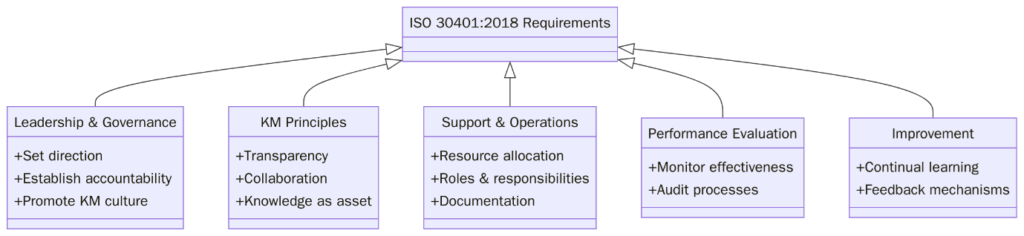
ISO 30401 specifies the requirements for a knowledge management system, focusing on strategic alignment, leadership commitment, resource allocation, and cultural support for knowledge-based activities. It does not prescribe specific tools or methods, giving organizations the flexibility to adopt knowledge strategies that suit their context.
Applicability:
If your organization depends on knowledge sharing and innovation, ISO 30401 provides a structured foundation for long-term value creation. Contact us at support@demo.pacificcert.com to know more!
Clause | Title | Overview |
1 | Scope | Defines the boundaries and purpose of the standard. |
2 | Normative References | Lists other ISO standards referenced for applicability. |
3 | Terms and Definitions | Provides terminology specific to knowledge management. |
4 | Context of the Organization | Requires understanding internal and external factors influencing KM, including stakeholder needs and strategic alignment. |
5 | Leadership | Outlines the role of top management in driving a KM culture, setting policies, and ensuring resource allocation. |
6 | Planning | Involves identifying KM risks and opportunities, setting measurable objectives, and planning processes. |
7 | Support | Covers competence, awareness, communication, and infrastructure to support KM. |
8 | Operation | Requires the establishment of KM processes that support knowledge identification, acquisition, sharing, and application. |
9 | Performance Evaluation | Involves monitoring, measurement, analysis, and internal audits of KM effectiveness. |
10 | Improvement | Focuses on continual improvement based on performance feedback, innovation, and learning. |
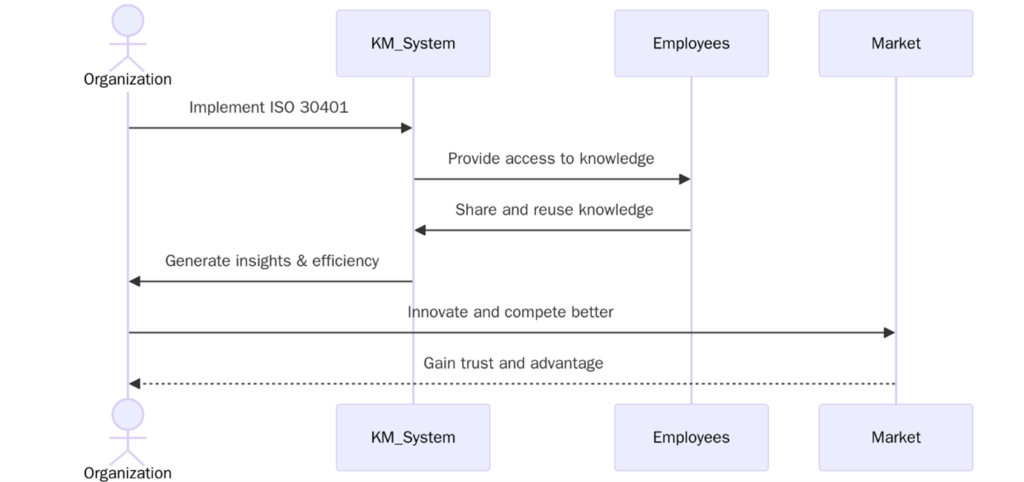
To implement ISO 30401, organizations must:
If you are planning to implement ISO 30401, contact us at support@demo.pacificcert.com
The ISO 30401 certification process typically spans 8 to 10 weeks, depending on the maturity of existing KM practices and system complexity.
Week-wise Breakdown
Week | Stage | Activity |
Week 1–2 | Application & Scope Definition | Define KM boundaries, scope of certification, and key stakeholders. |
Week 3–4 | Documentation Review | Review policies, KM framework, and internal procedures. |
Week 5 | Stage 1 Audit | Evaluate readiness of KM system, alignment with standard requirements. |
Week 6–7 | Stage 2 Audit | On-site or remote verification of implementation and effectiveness. |
Week 8–9 | Report Finalization & Corrective Actions | Address nonconformities, if any, and submit evidence of corrections. |
Week 10 | Certification Decision & Certificate Issuance | Receive ISO 30401 certification after successful audit. |
The cost of ISO 30401 certification depends on factors such as:
To request a cost estimate for ISO 30401 certification, contact us at support@demo.pacificcert.com.
As an ABIS-accredited certification body, Pacific Certifications offers independent, third-party audit and certification services for ISO 30401:2018.
We provide:
If you are looking for ISO 30401 certification, contact us at support@demo.pacificcert.com
Contact Pacific Certifications to begin your certification journey today!
Suggested Certifications –
Read more: Pacific Blogs

Get a rough Estimate for your Required Certification by entering your basic details.
This will close in 0 seconds
Get in touch!
This will close in 0 seconds