
The telecommunications industry helps people and businesses stay connected across every part of the world. It supports voice calls, mobile data satellite signals, video streaming and all kinds of internet-based communication. From using a smartphone to running cloud-based services everything we rely on each day depends on telecom systems working properly. These systems form the backbone of how modern society shares information builds relationships and operates across regions.
This industry includes many parts that work together to deliver nonstop service. It involves mobile towers fiber optic lines broadband infrastructure data centers and advanced software platforms. Telecom companies often manage global networks and must deal with both physical equipment and digital technology at the same time. As demand increases they are expected to provide faster connections stronger security and reliable service without any breaks. They also face challenges in energy use privacy rules and hardware upgrades that happen constantly.
ISO certifications are now playing a larger role in helping telecom companies stay organized and accountable. These standards offer a way to create reliable systems that improve service safety and data protection. Large providers and small operators alike use ISO standards to improve daily operations, support long-term planning and meet strict quality and safety goals. Certification also helps companies compete for contracts win client trust and keep up with industry changes without confusion or delay.
To begin your ISO journey or schedule an audit contact us at support@demo.pacificcert.com
Telecom companies work in fast-changing environments. New technologies are released regularly and rules around data privacy safety and sustainability keep evolving. Companies need to stay ready for changes in customer needs government regulations and market expectations. That creates constant pressure.
Each telecom operator faces a different set of challenges. A mobile service provider may need to manage equipment and data in real time while a broadband company might focus more on coverage and speed. Some work with international networks while others support local or regional systems. In every case these companies must avoid service failures protect customer information and maintain a reliable infrastructure.
ISO standards help by providing a structure that companies can use to manage different parts of their business. They bring clarity to how teams work and allow issues to be tracked more easily. They also make it simpler to go through audits and meet client requirements especially when working with government contracts or expanding into new markets. These standards help build better coordination across teams improve how suppliers are managed and create consistent results even in complex global operations.
ISO 9001 helps telecom providers improve product quality and customer service. It is widely used to monitor network reliability, manage suppliers, and standardize processes across service lines. From installation to support, it creates accountability.
This standard helps secure customer data and internal systems. It supports telecom companies in managing risks, access control, and breach response. It is especially important for ISPs, cloud service providers, and mobile operators.
ISO 14001 is used to manage energy use and reduce environmental impact. Telecom operations—such as base stations and server farms—often require large amounts of electricity. This standard helps track consumption and reduce waste.
Telecom services must remain available even during outages or disasters. ISO 22301 helps with planning for service continuity. It is widely used in disaster recovery planning, especially for companies with data centers or national coverage.
Telecom work can involve physical risks, including tower maintenance and electrical work. ISO 45001 helps keep field staff safe with documented procedures, incident tracking, and regular safety reviews.
Telecom companies operate in fast-changing environments where structured implementation is necessary to maintain quality, security, and reliability. ISO standards guide organizations through a series of key steps, helping them build internal systems that work under pressure. Meeting these requirements ensures that processes are not only documented but also consistently followed across the organization.
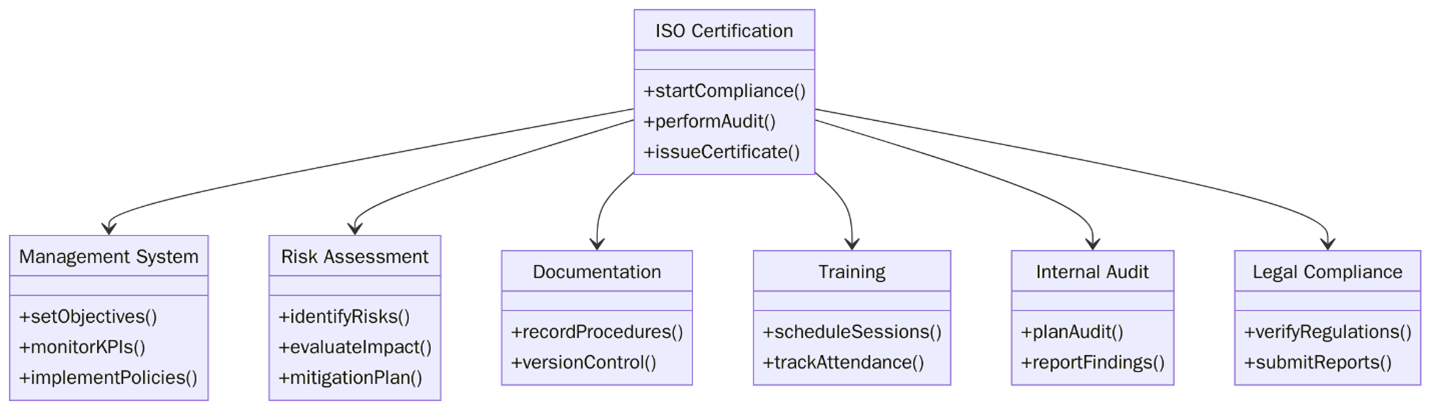
Getting certified isn’t just about meeting requirements – it helps telecom organizations deliver more stable, safer, and better-managed services. ISO-certified systems make everyday work more coordinated and reliable, especially when dealing with complex teams, multiple sites, or international contracts.
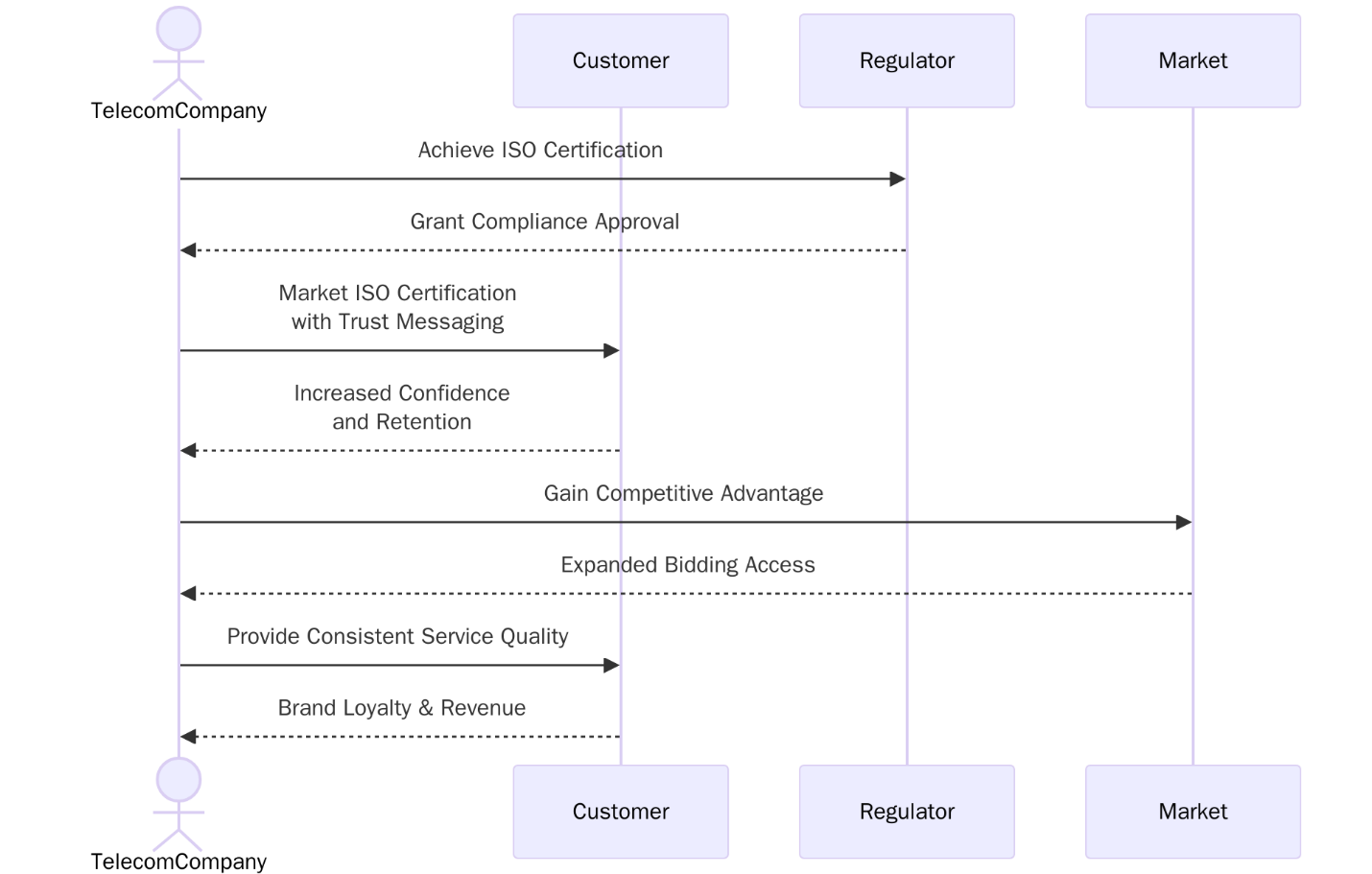
ISO certification in the telecom industry has steadily gained traction over the past few years. As companies deal with growing networks increasing data risks and rising customer expectations, more of them are turning to standards to bring order to daily operations. The table below shows how adoption has changed from 2020 to 2025 along with the reasons why certain standards are becoming more relevant across telecom businesses of all sizes.
ISO Standard | 2020 Adoption Rate | 2025 Projected Rate | Key Growth Drivers |
ISO 27001 | 48% | 72% | Increase in cyber risks and data protection rules |
ISO 9001 | 55% | 67% | Demand for reliable service delivery and better vendor oversight |
ISO 22301 | 26% | 45% | Focus on uptime, disaster recovery, and post-pandemic planning |
Pacific Certifications provides audit and certification services for telecom companies operating in wired, wireless, satellite, and data communications. Our audits focus on accuracy, traceability, and business relevance—not consulting or advisory services.
We do not provide consultancy services. Our focus is on impartial value-based audits.
Telecom teams often need ISO training for smoother implementation and better system ownership. Our training programs cover key standards relevant to this industry.
Pacific Certifications provides accredited training programs. If your organization is looking for ISO 27001, ISO 9001, ISO 22301 training, our team is equipped to help you. Contact us at support@demo.pacificcert.com.
Contact Pacific Certifications to begin your certification journey today!
Suggested Certifications –
Read more: Pacific Blogs
Get a rough Estimate for your Required Certification by entering your basic details.
This will close in 0 seconds
Get in touch!
This will close in 0 seconds