
The manufacturing industry remains a pillar of industrial development, with innovation, quality, and operational integrity at the top of its agenda. With business growth and changing customer expectations, compliance is increasingly important. ISO certifications provide a framework of structured requirements to enable manufacturers to achieve these expectations and set the foundation for long-term success. From small component fabricators to large-scale industrial manufacturers, implementing ISO standards builds a foundation for continual improvement and global competitiveness.
Obtaining an ISO certification is a declaration that your people, products, and processes measure up to global accepted quality standards. From quality control to environmental sustainability, ISO standards set the tone for improvement that resonates across all departments of a manufacturing organization.
For more information on becoming certified, write to support@demo.pacificcert.com.
Manufacturing businesses are under growing pressure to provide consistent products while keeping costs down and reducing risk. ISO certifications help achieve these objectives through providing systems that increase process effectiveness and bring operations into line with international standards. Businesses adopting ISO standards enjoy the virtues of an uncomplicated operational framework, reduced production faults, and enhanced transparency in supply chains.
Certifications also prove to regulators, customers, and business partners that your enterprise cares about compliance, safety, and sustainability. This also creates opportunities within competitive markets where certification is a requirement.
Manufacturing organizations face a wide range of operational safety challenges. ISO standards provide a structured framework to address these challenges while enhancing efficiency and customer satisfaction. Below are the most relevant ISO standards for manufacturers, each serving a specific purpose in improving processes and safety:
Focuses on process standardization, product consistency, and customer satisfaction; widely adopted across all manufacturing sectors.
Helps manufacturers manage environmental responsibilities, reduce waste, and comply with environmental regulations.
Ensures safe working conditions, reduces workplace risks, and demonstrates commitment to employee health.
Improves energy efficiency and reduces operating costs through structured energy performance monitoring.
Protects manufacturing data, intellectual property, and industrial control systems from cyber threats.
Provides a structured approach for identifying and mitigating operational, safety, and strategic risks.
Required for manufacturers of medical devices; aligns with regulatory requirements and product safety.
Essential for manufacturers and suppliers in the automotive sector; integrates with ISO 9001 for advanced product traceability and defect prevention.
Ensures manufacturing resilience by preparing for and responding to operational disruptions.
Assists in securing global manufacturing supply chains and mitigating logistics-related threats.
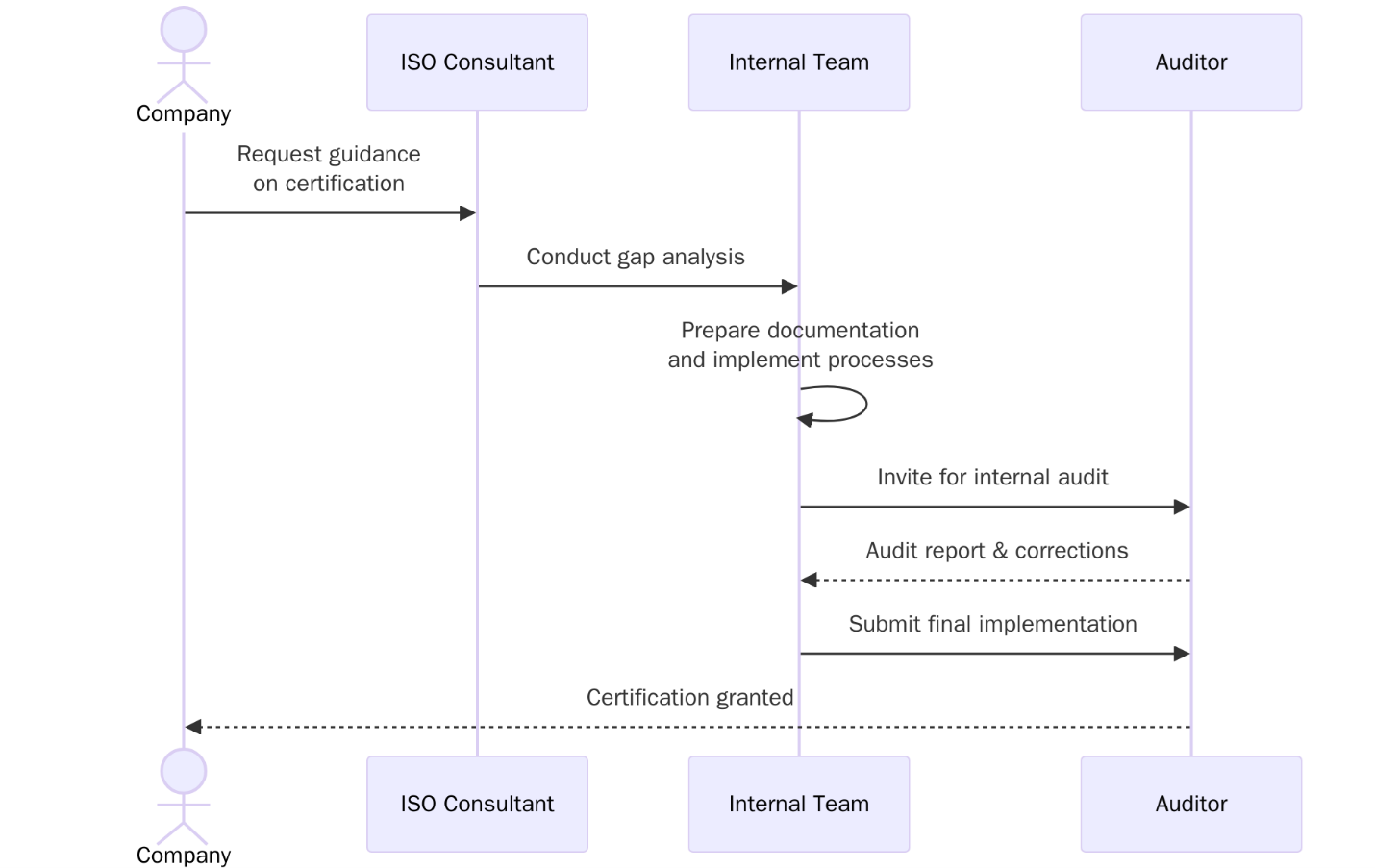
Producers pursuing ISO certifications are required to develop documented systems that accurately represent the clauses of the applicable standard. This normally entails establishing operating manuals, performing internal audits, training staff, and incorporating risk assessment into routine operations. After developing the systems, compliance is ascertained through a third-party audit. Below are the key requirements to fulfill:
To know more about the applicable requirements specific to your industry contact us at support@demo.pacificcert.com.
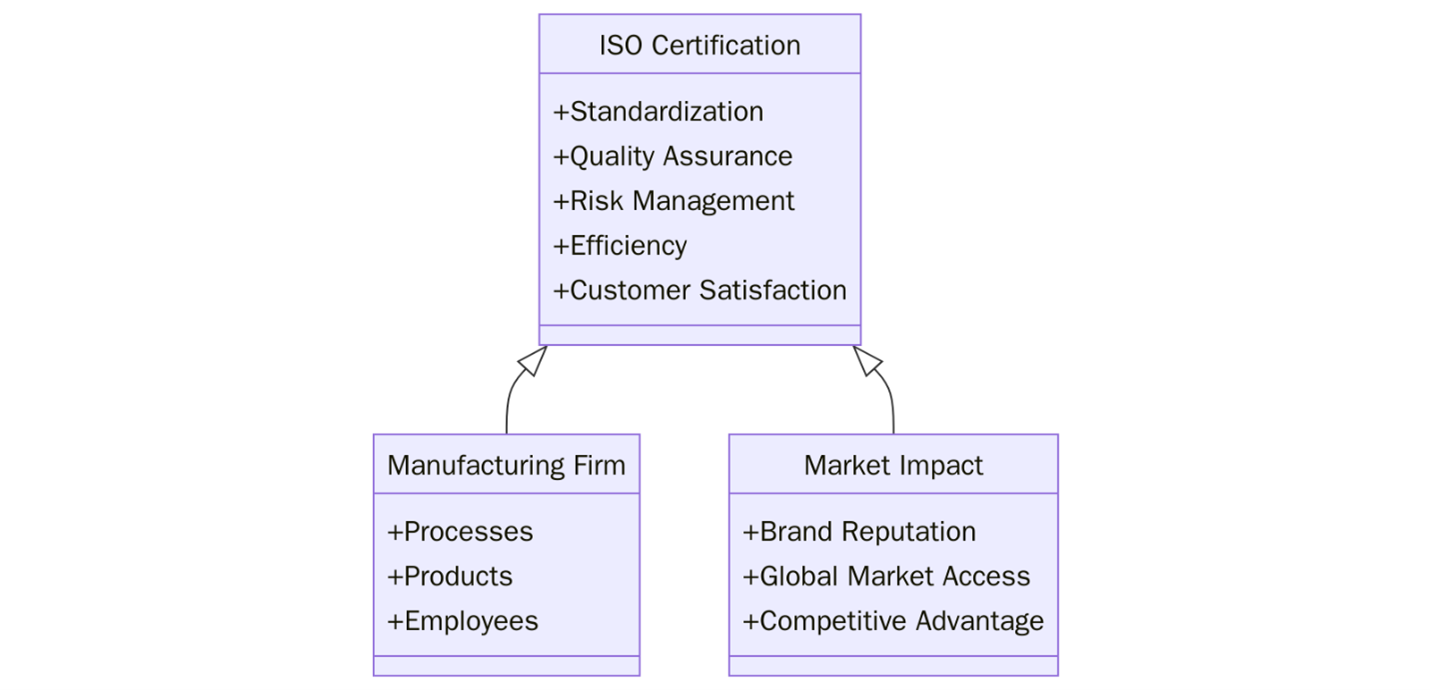
Manufacturing firms that become ISO certified realize quantifiable gains in several areas. Operationally, it encourages uniform processes and eliminates waste, resulting in cost savings. Strategically, certification builds brand credibility and sets the firm up for bigger contracts. Below are the benefits:
This year, the manufacturing industry is evolving quickly in response to trends resulting from digitalization, sustainability requirements, and changing trade policies. Pressure from regulation has rendered certifications like ISO 14001 and ISO 50001 more pressing than ever. As businesses become digitized, ISO 27001 is of growing importance for safeguarding intellectual property and key infrastructure.
Medical and healthcare supply chain manufacturers are seeing an increase in ISO 13485 certifications as a result of stringent regulation monitoring. Similarly, resilience and continuity planning, promoted by ISO 22301, have also become strategic imperatives in the face of global supply chain disruptions. ISO certifications are becoming a norm in an industry.
Between 2020 and 2025, ISO certification trends in the manufacturing industry have evolved significantly. In 2020, certification efforts were largely compliance-driven, primarily to meet supplier requirements and regulatory obligations. The certification process was heavily manual, with site-based audits and extensive physical documentation.
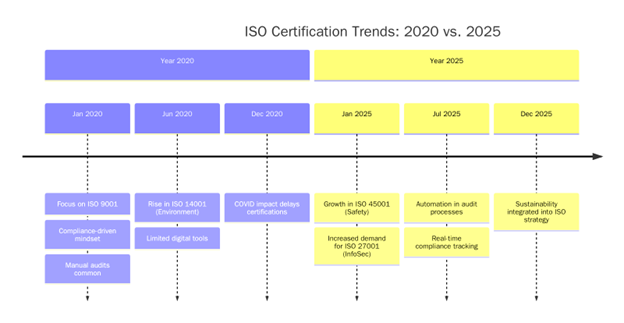
By 2025, the approach has become more strategic and technology-driven. Manufacturers are increasingly adopting remote audits, AI-supported compliance tools and digital documentation systems to streamline certification. There is a marked shift toward sustainability and resilience. The table below shows the growth and the trends:
ISO Standard | 2020 Adoption Rate (%) | 2025 Projected Adoption Rate (%) | Key Driver |
ISO 14001 | 45% | 68% | Sustainability Regulations |
ISO 50001 | 30% | 55% | Energy Efficiency Mandates |
ISO 27001 | 40% | 70% | Digitalization & Cybersecurity |
ISO 13485 | 28% | 60% | Medical Sector Regulation |
ISO 22301 | 15% | 48% | Supply Chain Continuity Needs |
Pacific Certifications, is an ABIS accredited certification body. We collaborate with manufacturers to provide independent and accredited ISO certification services. We conduct audits based on the chosen ISO standards and lead organizations through the certification process professionally and ethically. Our work is to assess current systems and verify that they comply with the requirements of international standards.
Our services include:
For any further questions or to start your ISO journey, email us at support@demo.pacificcert.com.
Contact Pacific Certifications to begin your certification journey today!
Suggested Certifications –
Read more: Pacific Blogs
Get a rough Estimate for your Required Certification by entering your basic details.
This will close in 0 seconds
Get in touch!
This will close in 0 seconds